Chittorgarh is approximately 310 km from Jaipur by road. The journey usually takes around 5 to 5.5 hours by car, depending on traffic and road conditions. Starting early is recommended for a comfortable journey and enough sightseeing time.


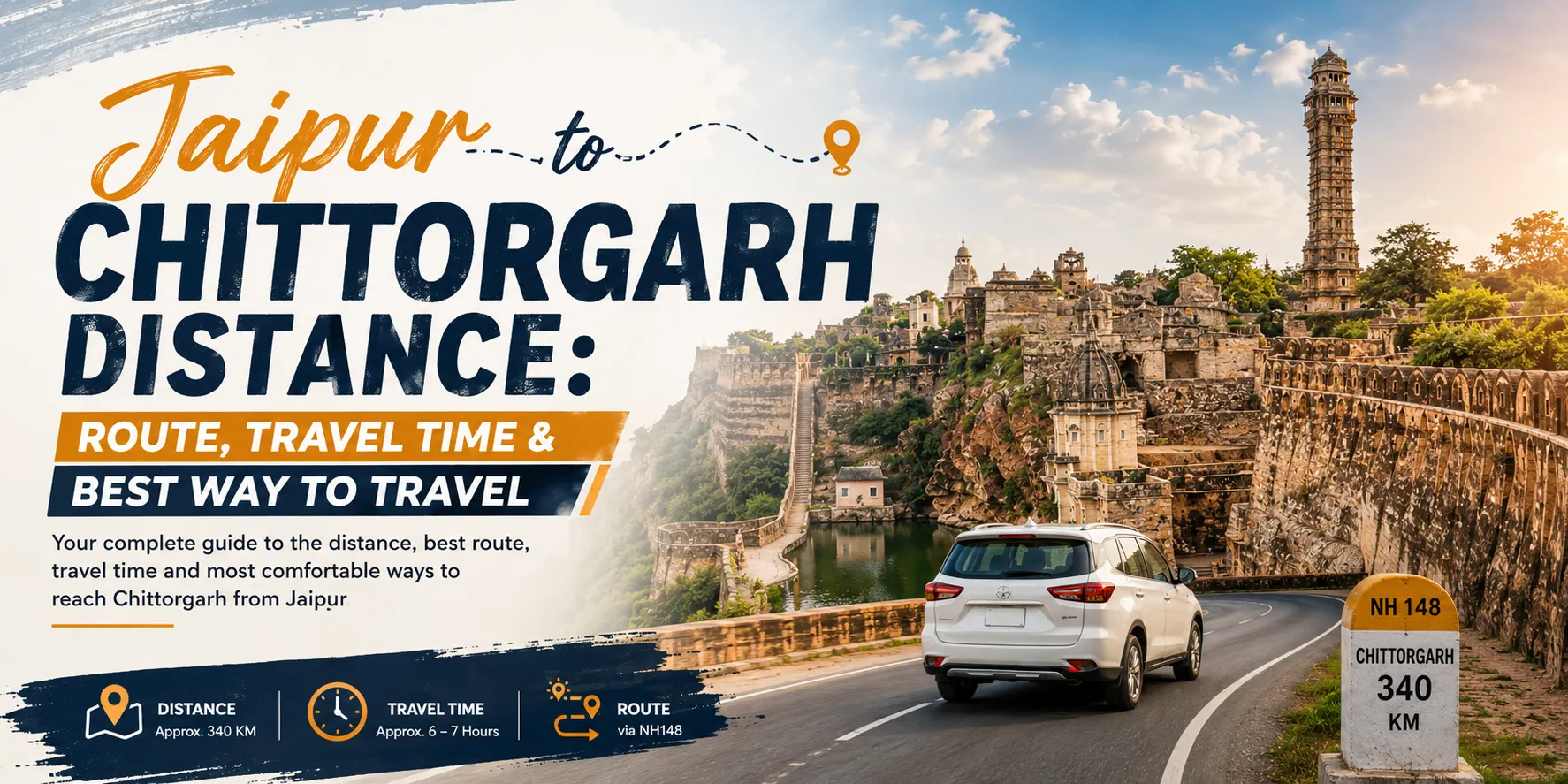
The distance between Jaipur to Chittorgarh is approximately 310 kilometres by road and the drive takes around 5 to 5.5 hours depending on traffic and road conditions. The fastest and most reliable option is NH48 via Kishangarh and Bhilwara, a well-maintained highway route with 4 to 5 toll plazas along the way.
Aerial distance between the two cities is shorter, around 253 km, but that figure isn't usable for actual road travel — it only matters if you're comparing straight-line distances. Beyond driving, Chittorgarh is also reachable by train (4.5 to 6 hours) and bus (6 to 7 hours), though a private car remains the most comfortable and time-efficient option for this route.
Chittorgarh Fort itself — the main reason most people make this trip — is open daily from 9:00 AM to 6:00 PM, with entry starting at ₹40 for Indian visitors and typically takes 2 to 4 hours to explore properly.
| Detail | Information |
|---|---|
| Road distance | ~310 km |
| Aerial (straight-line) distance | ~253 km |
| Travel time by car | 5 to 5.5 hours |
| Travel time by bus | 6 to 7 hours |
| Travel time by train | 4.5 to 6 hours |
| Best route | NH48 via Kishangarh and Bhilwara |
| Toll plazas on route | 4 to 5 |
| Approx. toll cost (one way) | ₹500 to ₹600 |
| Best time to visit | October to March |
A quick note on the distance confusion you'll see online: some sites quote the aerial (straight-line) distance, around 253 km, which isn't usable for actual travel. Others quote figures up to 350–360 km based on longer route calculations. The 310 km figure here reflects the standard NH48 driving route and matches what multiple independent travel operators report.
Chittorgarh sits directly on the road between Jaipur and Udaipur, so a good number of travellers pass through it on the way to somewhere else. But plenty come specifically for Chittorgarh — the fort alone is reason enough, being one of the largest fort complexes in India with centuries of Mewar history inside it. Others are drawn by the temples in the region, particularly Kalika Mata and Meera Temple, both within the fort premises.
| Route | Distance | Time | Road Condition | Best For |
|---|---|---|---|---|
| NH48 via Kishangarh–Bhilwara | ~310 km | 5–5.5 hrs | Well-maintained highway | Fastest, most direct option |
| Via Ajmer–Nathdwara | ~330 km | 6–6.5 hrs | Mix of highway and state roads | Combining a Pushkar or Nathdwara stop |
Turn-by-turn breakdown of the NH48 route:
This route stays almost entirely on national highway with consistently good surface quality and the Bhilwara stretch has enough dhabas and fuel stations that you won't need to plan stops in advance. Travelling via NH48, you'll pass 4 to 5 toll plazas, with total one-way toll cost usually between ₹500 and ₹600 for a standard car. Keeping a FASTag active avoids delays, since cash lanes move slower during peak hours.
| Mode | Time | Approx. Cost | Comfort Level | Best For |
|---|---|---|---|---|
| Chauffeur-driven luxury car | 5–5.5 hrs | Premium, fixed pricing | High — no driving fatigue | Comfort travellers, families, business trips |
| Self-drive car | 5–5.5 hrs | Fuel + tolls | Moderate — driver fatigue on long stretch | Independent travellers used to highway driving |
| Shared/private cab | 5–6 hrs | Budget to mid-range | Moderate | Budget-conscious solo or small-group travel |
| Bus (RSRTC/private) | 6–7 hrs | Low | Basic | Solo budget travellers |
| Train | 4.5–6 hrs | Low to moderate | Moderate — limited schedule flexibility | Travellers without much luggage |
A five-hour-plus highway drive is long enough that the choice of transport genuinely changes how the trip feels. Self-driving gives you control but means arriving tired. A private cab solves fatigue but comes with variable vehicle condition and driver experience. For families with elderly members or children, or business travellers who need to be functional on arrival, a chauffeur-driven car tends to be the more sensible option.
Choosing the right car for a 5–5.5 hour journey can make a noticeable difference, especially if you're travelling with family or planning to explore Chittorgarh after arrival. Luxoria focuses on comfortable chauffeur-driven travel with vehicle options suited to different group sizes and travel requirements.
This is the part most trip planners actually need before they leave home.
| Detail | Information |
|---|---|
| Fort timings | 9:00 AM to 6:00 PM, all days |
| Entry fee (Indian visitors) | ₹40 per person |
| Entry fee (children under 15) | Free |
| Entry fee (foreign visitors) | ₹600 per person |
| Light & Sound Show timing | 7:00 PM to 8:00 PM |
| Light & Sound Show fee (Indian) | ₹100 approx |
| Light & Sound Show fee (foreign) | ₹300 approx |
| Time needed to explore | 2 to 4 hours |
| Distance from Chittorgarh railway station to fort | Approximately 6 km |
| Local transport at fort | Autos and cabs available; the fort is spread out, so walking the entire complex on foot is not practical |
The fort trust also organises the light and sound show most evenings, narrating the fort's history — worth planning your day around if you're staying overnight. Ticket prices are revised periodically, so it's sensible to confirm current rates before your visit.
If you're doing this as a two-day trip or arriving later in the day, Chittorgarh has options across every budget.
Booking ahead is worth doing if you're travelling during the Chaitra or Ashwin Purnima mela season, when rooms fill up faster than usual.
Rajasthani thalis are the obvious starting point — most mid-range hotels and local restaurants near the fort road serve a full thali with dal baati churma, gatte ki sabzi and ker sangri, which gives you a fair sense of regional flavour in one meal.
For something lighter, the Fort Road market near the fort entrance has small eateries serving kachori, pyaaz ki kachori and mirchi bada — good for a mid-morning stop before or after visiting the monuments. If you're travelling via NH48, the dhabas around Bhilwara are known for solid, no-frills North Indian food and are a sensible stop to break up the drive.
Street food near the fort tends to get busy in the evening once the light and sound show crowd starts moving through, so an earlier stop usually means shorter waits.
Chittorgarh Fort is spread across nearly 700 acres on a hilltop and stands as one of the largest fort complexes in India, recognised as a UNESCO World Heritage Site under the Hill Forts of Rajasthan. It has withstood three major historical sieges and its structures reflect that layered past rather than a single period of construction.
A nine-storey 15th-century tower covered in detailed carvings and one of the most photographed structures in the fort. The top offers a 360-degree view of the complex and surrounding plains, best at sunrise or sunset.
The oldest surviving structure in the complex, linked to several key events in Mewar's history, including the birth of Maharana Udai Singh II, founder of Udaipur.
A smaller, water-facing palace tied to the legend of Rani Padmini; the reflection of the palace in its surrounding water body is a popular photo spot, especially in morning light.
Dedicated to the poet-saint Meera Bai, quieter than the more visited monuments nearby.
An old temple that draws a steady stream of devotees, including many passing through on a longer pilgrimage circuit.
The fort has seven gates, of which Ram Pol and Suraj Pol are the most notable entry points. Given the size of the complex, hiring a local guide (typically around ₹400 for a few hours) or an auto/cab to move between sites is more practical than trying to cover it entirely on foot.
October to March remains the best window. Temperatures stay comfortable through the day, which matters given how much walking the fort involves. April to June brings intense heat, often above 40°C, making both the drive and the fort walk noticeably harder. July to September, the monsoon period, adds greenery to the drive but occasional waterlogging or slower highway stretches are possible — worth building in extra buffer time if travelling then.
If you're still deciding between destinations, here's how Chittorgarh compares to a couple of other popular routes from Jaipur:
| Destination | Distance from Jaipur | Travel Time | Best For |
|---|---|---|---|
| Chittorgarh | ~310 km | 5–5.5 hrs | History, forts, heritage architecture |
| Udaipur | ~395 km | 6.5–7 hrs | Lakes, palaces, romantic getaways |
| Pushkar | ~145 km | 2.5–3 hrs | Quick spiritual trip, lake and temples |
Chittorgarh sits in a useful middle ground — far enough to feel like a proper trip, close enough to manage in a long day if needed, and it works well as a stopover if you're eventually heading to Udaipur rather than doing it as an isolated round trip.
Chittorgarh is approximately 310 km from Jaipur by road. The journey usually takes around 5 to 5.5 hours by car, depending on traffic and road conditions. Starting early is recommended for a comfortable journey and enough sightseeing time.
The entry fee is around ₹40 for Indian visitors and ₹600 for foreign visitors. Children below 15 years can enter free. Ticket prices and entry rules may change, so checking the latest information before visiting is recommended.
The preferred route is NH48 via Kishangarh and Bhilwara. It offers good road conditions and a convenient drive for most travellers. The journey generally takes around 5 to 5.5 hours, depending on traffic and stops.
Hiring a chauffeur-driven car can be more comfortable for this long journey. You can relax instead of driving continuously for several hours. It also helps reduce driver fatigue and gives you more energy to explore Chittorgarh after arrival.
Yes, Chittorgarh can be visited as a day trip from Jaipur with an early morning start. However, the return journey is long and Chittorgarh Fort itself needs around 2 to 4 hours to explore. An overnight stay is better for a relaxed trip.
The best time is generally October to March, when the weather is comfortable for travelling and sightseeing. Winter is especially suitable for exploring Chittorgarh Fort. Summers can be quite hot, particularly during afternoon hours.
Taxi fares depend on the car type, trip duration and one-way or round-trip booking. Sedan, SUV and larger cars have different rates. Before booking, confirm whether tolls, parking, driver charges and sightseeing are included in the fare.
The main attraction is Chittorgarh Fort, where you can visit Vijay Stambh, Kirti Stambh, Rana Kumbha Palace, Meera Temple and Padmini Palace. The fort has several historical landmarks, so keeping at least a few hours for sightseeing is recommended.
You should keep around 2 to 4 hours to explore the major attractions of Chittorgarh Fort. Since the fort is spread across a large area, comfortable footwear and water are recommended, especially during warmer months.
Yes, Jaipur to Chittorgarh is a good Rajasthan road trip, especially for families and groups. The approximately 310 km journey takes around 5 to 5.5 hours by car. A private cab provides flexibility for breaks and sightseeing.

Experience seamless luxury travel with Luxoria and book your premium ride for comfort, style, and elegance.